Let’s talk about your EHR needs: 1.800.383.6278 MEDHOST Community Login


For rural and community hospitals, efficiency and connectivity aren’t just important—they're essential. With increasing pressure to reduce costs, improve outcomes, and enhance the patient experience, these hospitals and clinics must find smarter ways to manage the flow of orders, results, and referrals, often with less access to resources and technology.
One area ripe for improvement is how outpatient lab and radiology orders are handled. Whether it's a routine blood test or a complex imaging scan, the process of placing, tracking, and fulfilling orders often involves fragmented communication, manual data entry, and administrative back-and-forth. These inefficiencies don’t just slow down care—they increase the likelihood of claim denials, scheduling delays, and patient frustration. That translates to a very real impact on the bottom line.
For many smaller healthcare organizations, the referral workflow still relies on outdated methods like phone calls, paper forms, or faxed documents. These manual processes often lead to:
At a time when these types of organizations are working hard to optimize both revenue and resource utilization, continuing to manage outpatient orders with inefficient systems is a significant source of revenue leakage.
Creating a tighter connection between clinics and hospitals can transform how lab and radiology orders are processed. When orders and results can be shared electronically—and encounters can be created automatically—teams spend less time chasing paperwork and more time focused on patient care.
Even small improvements in this workflow can have a big impact:
Ultimately, a streamlined order and result management process is not just an operational win—it’s a clinical one.
To support this kind of efficiency, MEDHOST offers YourCare Continuum® (YCC)—a web-based platform designed to simplify the ordering, scheduling, and results exchange between clinics and hospitals.
YCC enables:
By eliminating manual steps and creating visibility across the entire order lifecycle, YourCare Continuum helps hospitals strengthen relationships with referring clinics, optimize referral revenue, and provide a smoother patient experience.
To learn more about how YCC can help your organization close gaps in lab and radiology order workflows, reach out to us at inquiries@medhost.com or call 1.800.383.6278.
Patient leakage is pretty much what it sounds like—losing patients. Specifically, it’s when they move from in-network primary care physicians to out-of-network specialists or services, and it can significantly impact a hospital’s bottom line.
Streamlining scheduling processes is key to preventing leakage. Here, we’ll unpack the five most effective strategies and explore how MEDHOST is helping our partners keep exceptional patient outcomes in-house.
Establish a seamless coordination system that links primary care providers with in-network specialists and services. This facilitates easier referrals and appointments, ensuring patients receive comprehensive care within the same network.
MEDHOST offers solutions like YourCare Continuum® to help manage referrals effectively.
Implement a user-friendly and efficient scheduling system. This may involve online booking platforms that allow patients to view available slots and book appointments with specialists within the network, reducing the likelihood of them seeking care elsewhere.
MEDHOST Patient Access Solutions provide the tools needed to streamline this process, enhancing patient retention.
One patient, one record—that’s the idea. Utilize integrated communication tools to ensure all parties involved in patient care, including primary care providers, specialists, and patients, are kept informed about appointments, test results, and treatment plans.
MEDHOST Secure Communications offers a single platform for effective and universal information sharing, ensuring patients and providers are always connected.
Educate patients about the benefits of receiving care within the network, such as coordinated treatment plans, shared medical records, and potentially lower costs.
Awareness campaigns can emphasize the convenience and quality of care available within the network. MEDHOST's range of Patient Engagement solutions can help effectively disseminate this information and involve patients more deeply in their care.
Continuously monitor the effectiveness of the scheduling system and seek feedback from both patients and healthcare providers. Use this feedback to make necessary adjustments to further reduce patient leakage.
MEDHOST's Healthcare Analytics Solutions can play a pivotal role in analyzing trends, patient feedback, and system performance to continually improve the scheduling process.
By focusing on these strategies, healthcare facilities can create a more cohesive and efficient healthcare experience for their patients, ensuring they receive the best possible care within their own network.
If you're interested in learning more, email us at inquiries@medhost.com or call 1.800.383.6278.
Metropolitan hospitals usually enjoy an extensive network of clinics and facilities with integrated health information exchange; in contrast, community hospitals - owning certain clinical practices and forming affiliations with others - must cobble together ad hoc networks of care.
This mix of affiliation and ownership results in a patchwork of interconnected technology platforms that don't necessarily talk with one another and can be costly to replace or upgrade.
Fragmented systems and lack of communication between these entities often lead to delays and missteps in patient care. In this blog, we'll tackle how providers can implement digital communication tools to improve coordination between clinics and hospitals while maintaining existing technology investments and controlling costs.
Web-based scheduling and referral solutions have shown promising results in streamlining scheduling processes, reducing the burden on hospital staff, and boosting patient satisfaction. Digitally managed testing and procedures can also enhance patient referrals, making them easier, faster, and more convenient, thereby retaining revenue within the hospital.
Digital care coordination solutions offer several benefits, such as bridging gaps between clinics and hospitals, affordability, and ease of implementation, leading to immediate returns on investment. These solutions enable better care coordination by tracking scheduling requests, simplifying front-end functions, and capturing patient visits immediately.
Hospitals stand to lose up to 20 percent of revenue due to gaps or inefficiencies in their referral processes. Improving care coordination reduces operational inefficiencies and enhances the overall quality of care provided, benefiting healthcare organizations and patients alike.
For instance, web-based applications enable providers to improve care coordination by tracking scheduling requests and simplifying front-end functions like pre-authorizations, medical necessity, and appropriate use criteria (AUC).
Best of all, electronic solutions are affordable and straightforward to implement, resulting in immediate returns on operating dollars.
YourCare Continuum is an all-in-one platform that works with existing technology investments to unify communities of care where it's needed most.
The platform works by streamlining the order referral process for patients and providers, increasing visibility, and eliminating unnecessary back-and-forth. It automatically identifies elements that require verification and transfers order referrals, reducing manual efforts.
To explore how MEDHOST's digital care coordination solutions can benefit your facility, contact us at inquiries@medhost.com or call 1.800.383.6278.
Expanded performance to create even smoother bi-directional transition of care for community hospitals.
FRANKLIN, Tenn., March 16, 2021 – MEDHOST®, a leading EHR (electronic health record) and healthcare IT solutions provider, is now offering an enhanced care coordination solution, YourCare Continuum®, to help healthcare communities manage patient care coordination and transitions with greater efficiency. This solution will enable even smoother interoperability between hospitals and the clinics in their networks, driving more positive clinician and patient experiences while maintaining current ambulatory investments.
“The integrated system of care has come to community hospitals; however, IT interoperability remains one of the top challenges to effectively executing a hospital’s ambulatory strategy,” said Bill Anderson, Chairman and CEO at MEDHOST. “With YourCare Continuum, our customers can resolve these challenges and streamline care coordination without having to sacrifice performance or add costs by replacing disparate IT systems.”
The new enhancements allow hospitals to provide interoperable scheduling, orders and results management, and data access across the continuum of care. This enhanced patient care coordination across providers promotes a seamless and efficient patient experience and can help alleviate financial loss resulting from patient leakage and readmission penalties.
“Patient and clinician needs will continue to evolve, quite rapidly at times, as we have seen,” added Anderson. “We are here to help our customers adapt to those changes in ways that won’t hinder their core purpose. This enhanced version of YourCare Continuum reflects that mission.”
About MEDHOST
MEDHOST has been providing products and services to healthcare facilities of all types and sizes for over 35 years. Today, more than 1,000 healthcare facilities are partnering with MEDHOST and enhancing their patient care and operational excellence with its clinical and financial solutions, which includes an integrated EHR solution. MEDHOST also offers a comprehensive emergency department information system with business and reporting tools. Additionally, its unparalleled support and cloud solutions make it easy to focus on what’s important for healthcare facilities: their patients and business. Connect with MEDHOST on Twitter, Facebook and LinkedIn.
Samra Khan
Senior Marketing Manager
615-761-1000, ext. 2119
samra.khan@medhost.com
YourCare Continuum® enhances quality of care and clinician experience in community hospitals and clinics while promoting improved financial performance. MEDHOST customers utilizing YourCare Continuum can increase revenues by retaining outpatient revenues going to third parties and by decreasing missed appointments.
Our solution allows customers to maintain their investment in ambulatory and other systems while giving physicians a consolidated view of the patient. YourCare Continuum supports efficient management of transitions of care by facilitating the ability to order and schedule across platforms and instances of care. This role-based system may be integrated with any Health Information System (HIS) (ambulatory or inpatient) and allows for greater staff efficiency and an opportunity to increase revenue from reduced no-shows, denials, and underpayments.
Patient satisfaction drops when a patient receives an unexpected bill from their provider for a surprise charge for missing an appointment.
While it is reasonable for providers to charge this fee, both the patient and the provider feel the burden of no-show appointments. The provider loses revenue because of no-shows and experiences operational burdens, while the patient also risks further health issues and bears the financial loss.
When healthcare providers were asked, “What is your biggest challenge with appointments?” in an Oct. 2017 MGMA Stat poll, 44 percent noted no-shows or missed appointments. These no-shows cost the US healthcare system more than $150 billion a year, and the regular appointment skippers often end up paying for more expensive emergency care in the long run.
So why do patients skip appointments without canceling? For most no-show patients, the circumstances vary from their busy lives to inefficient scheduling processes to their health issues and even transportation issues. Although patients are responsible for keeping appointments, no-shows put an enormous individual and collective strain on our healthcare system. A no-show often takes an appointment away from patients in need of urgent care, and the hospital or a clinic’s resources are ultimately wasted, costing the provider. Though punitive measures may be in place, these only warn patients for future occurrences and recover only a fraction of lost revenue while creating a negative experience for the patients. The best approach would be for providers to craft systems that help avoid no-shows.
A study published in the American Journal of Medicine in 2010 reported that the no-show rate was 23.1 percent for those who received no reminder, compared to 17.3 percent for those receiving an automated appointment reminder, and down to 13.6 percent if a staff member made a call.
Despite this improvement, human calls can be unreliable and add to the already piling workload of the care staff. To account for this, email and text reminders may be the best options. When tested, response rates for appointment reminders were significantly higher at 52 percent for text messages, 28 percent for emails, and 26 percent for phone reminders. Using an efficient system that sends email and text reminders based on patient preference and response may prove to be the perfect solution in curtailing no-show appointments for both patients and providers.2
Want to learn more about how MEDHOST can help reduce the no-show rates with the ability to send text and email reminders automatically? Contact us at inquiries@medhost.com or call 1.800.383.6278.
The integrated system of care has come to the community hospital as it seeks to improve patient results and lower costs.
Unlike the urban setting where this has become the de facto standard, community hospitals seldom have a wide selection of providers and facilities from which to craft this integrated system or the financial resources available to many large urban systems. Physician practices may be acquired, created, or just closely affiliated. These communities may have established nursing homes, skilled nursing facilities, or other step-down facilities that are traditionally independent or owned by third parties. This environment makes care coordination difficult and inefficient as each encounter may start as a new patient and downstream follow-up is not digital.
When money is no object and decisions are made centrally, the easy answer is to rip out all existing IT systems and install a single platform. Most of us, however, live in the real world. We need to improve patient outcomes by enabling clinicians to order, schedule, and access data across the continuum of care while preserving existing IT investments. Recent Federal regulations recognize this problem and mandates such as prompted by the Cures Act are a step toward solving the problem. Unfortunately, there are hundreds of electronic health records and supporting systems that were built over a long period of time on different technology platforms, with different file formats and naming conventions, and different workflows. A seamless regulatory solution is improbable in the foreseeable future and it will likely be a very painful progression.
Just as the community hospital is the community’s healthcare hub, it must also be the IT hub for an integrated community of care. Today’s environment requires flexibility and use of both old and new interoperability tools, but the rewards are significant. MEDHOST community hospitals partnering with their electronic health record (EHR) provider can go beyond traditional interfaces to use new interoperability solutions that allow for more than just electronic order and results integration. Solutions can now also provide integrated community scheduling of services, automation of financial verification tasks, and workflow management tools. This type of solution allows hospitals to lower costs and maximize revenue while delivering a more seamless patient and provider experience.
YourCare Continuum® from MEDHOST enables our customers to craft communities of care while preserving IT investments and achieving a one-patient, one-record experience. Learn more about how we can help by contacting us at inquiries@medhost.com or calling 1.800.383.6278.
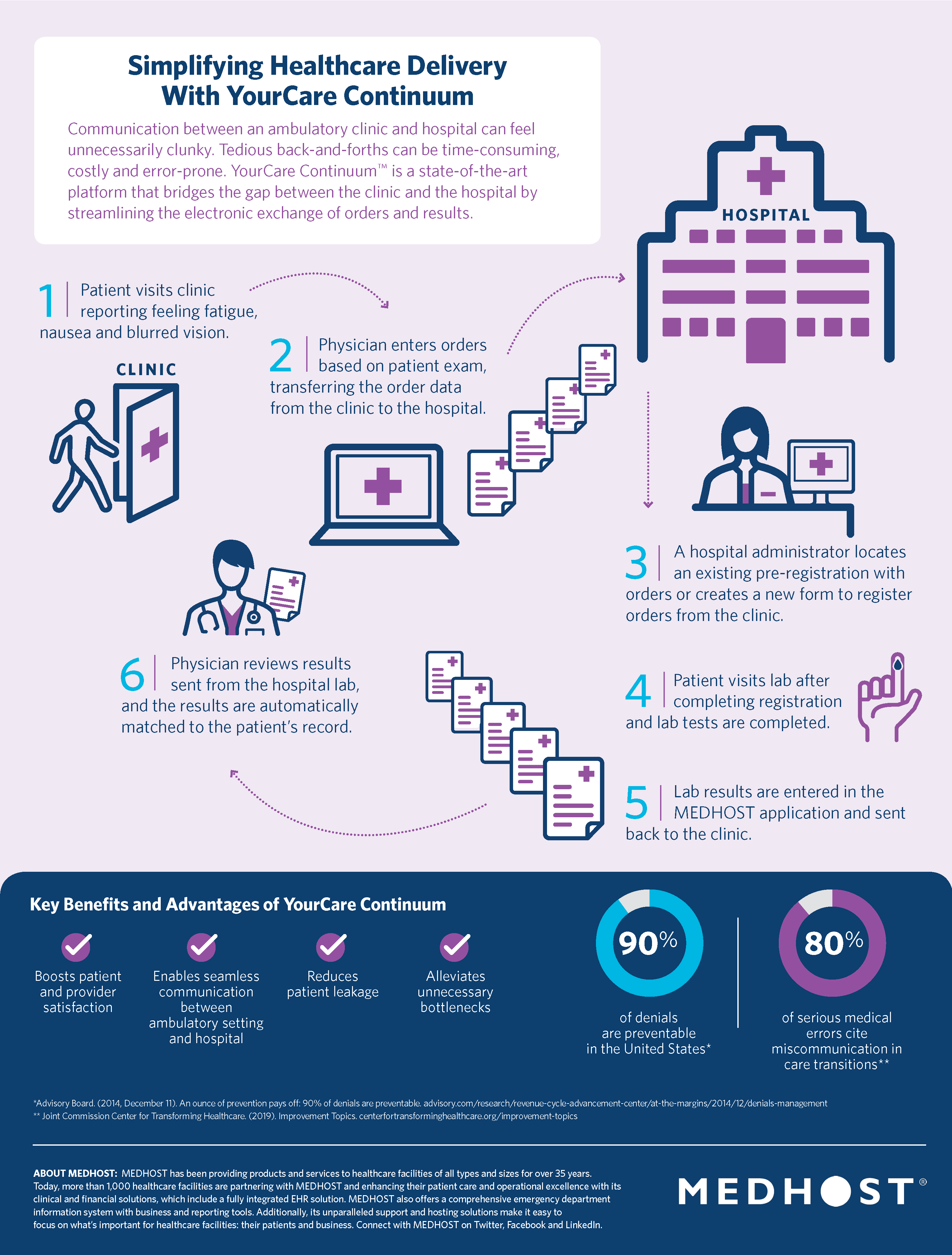
Tedious workflows can stall healthcare delivery, resulting in unnecessary bottlenecks, unhappy patients, and costly errors.
Because both patients and providers deserve more effective and efficient results, hospitals and health systems should consider an improved healthcare IT (HIT) solution.
MEDHOST’s YourCare Continuum™ offers a platform to streamline and simplify the electronic exchange of information between ambulatory clinics and hospitals.
Download the infographic about MEDHOST’s YourCare Continuum.
To learn more about how YourCare Continuum can streamline the workflow in your hospital or healthcare organization, email us at inquiries@medhost.com or call 1.800.383.6278 to speak with one of our specialists.
Don’t forget to subscribe to keep up-to-date with the latest happenings in healthcare IT news! Follow us on LinkedIn, Twitter and Facebook, subscribe to our blog, and check out our resource center.
Imperfect care coordination can result in barriers along a patient’s healthcare journey, a reality that frustrates patients and providers.
To smooth the patient’s path to receiving efficient and effective care, providers can invest in savvy patient-centric tools to avoid those inevitable roadblocks. Our map below illustrates how YourCare Continuum helps get you to the top of patient care.
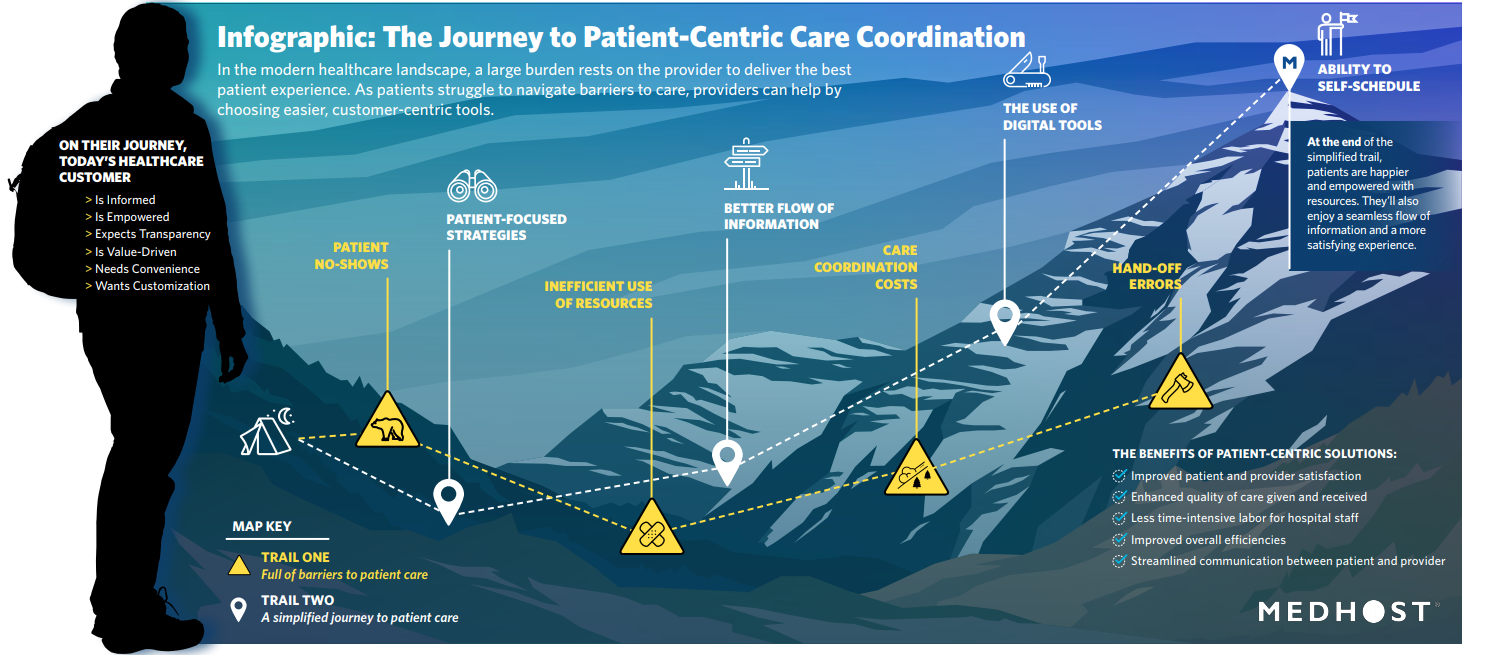
To streamline patient care coordination, hospitals and healthcare facilities should implement customer-centric processes that prioritize the patient experience.
Adopting intuitive, simplified solutions that mirror the anatomy of today’s healthcare customer will mean patients get the care they need faster and enjoy a more satisfying experience too.
Learn more about how YourCare ContinuumTM can improve patient care coordination in your facility!
Gina Williams, Senior Product Manager at MEDHOST, leads YourCare Continuum® - an orders integration and appointment scheduling platform - that makes it easier for patients to get the help they need. In this episode, she walks us through the maze of manual referrals, admissions, and follow-ups that patients have to navigate for each provider they seek.
Alongside an enthusiastic beta partner, MEDHOST is working to cut down on the 54% of fax referrals and 50% of call referrals that fall through the cracks to create a better, more reliable experience for both the patient and provider.
Health IT on the Record, presented by MEDHOST, explores how innovations in health information technology impact every aspect of a health system, from multi-hospital networks down to individual patients.
Subscribe now and get access to more MEDHOST “Health IT on the Record” episodes.
Host: That's Gina Williams, product manager at MEDHOST. She's currently working on YourCare Continuum, an orders-integration and appointment-scheduling platform that makes it easier and more enjoyable for patients to get the help they need. She gives us an example by walking us through how a patient previously had to navigate a maze of manual referrals, admissions, and follow-ups for each provider they sought care from and how YourCare Continuum cuts down on the frustration that stops people from accessing critical services.
Gina: At the end of the day, these providers want their patients healthy. And they want to be able to take good care of their patient so that they can see new, healthy patients rather than continuing having to treat the same person for the same thing because they're not getting the other treatment that they need.
Host: This is Health IT on the Record, presented by MEDHOST, a show that dives into how health information technology innovations impact every aspect of a health system from multi-hospital networks down to individual patients. Alongside an enthusiastic beta partner, MEDHOST is working to cut down on the 54% of fax referrals and 50% of call referrals that fall through the cracks to create a better, more reliable experience for both patient and provider. Enjoy the conversation.
Gina: Hello. My name is Gina Williams, and I'm a product manager at MEDHOST. And my latest project has been to help identify problems, to help craft a solution, and to sort of shepherd a beta launch for our new YourCare Continuum product.
Host: Community Bridge. Walk me through just the context of all of this: why there's a pain, what you've been working on to take away that pain. And let's just start there.
Gina: Sure. So the problem that exists across the entire healthcare ecosystem is that patients and providers are largely disjointed. So as patients move through multiple providers of care including physician practices, acute care health setting, etc., the coordination and transition of that care is critical for ensuring the best patient outcome and ensuring a satisfied patient. I was going to say happy, but I think satisfied is probably the better way to say that.
Host: Right. So kind of if you were to make this an example, just like making up a name, could you walk me through this broken model?
Gina: Sure. So Clark –
Host: Yeah. Use me.
Gina: Yes. Clark shatters his leg skiing and is taken to the emergency department. Physician there patches up Clark's leg and says, "Okay. Now you have to go see specialist. You're going to have to go see an orthopedist. I'm pretty sure you're going to have to have surgery, but I want to refer you to an orthopedist to evaluate."
You go to the orthopedist, and the orthopedist says, "Yeah. This X-ray looks bad, but I really want you to have an ultrasound." So they refer you back to the hospital for an ultrasound. They get those results back and say, "Yep. You're going to need surgery, and you're going to have to spend the night. So I'm going to go ahead and put in all of my admission orders and everything in at the hospital for your stay."
Then you have surgery. Well, then you need to follow up with the orthopedist, and they also want you to follow up with your primary care physician so that he can be fully aware of everything that you've been going through. This is a lot of transitioning of care across multiple providers for Clark. And with no electronic coordination, all of that is manual. So all of those orders, maybe the MRI or the ultrasound that they want Clark to have, they print out a piece of paper and hand it to Clark. And then Clark leaves it in the car when he goes.
Host: Right. I do that.
Gina: And they won't let you have the test. So Clark, who already is in pain because he's got a broken leg, has to go back to the car to get the order before he can come back and have the test done. So it's really inconvenient. And you're asking people who are already not well, typically, if they're moving across providers like that – so we were trying to look at some way that we could tackle that one bite at a time. It's a huge problem.
One of the things that MEDHOST already had was electronic orders. So we have the orders back and forth electronically, but there's no workflow around those orders. So there's still a lot of things that have to happen to that order in order for it to be closed to say, "So all pre-registration activities have to happen. You have to make sure that it's medically necessary. That if a pre-authorization is needed from insurance, that that's obtained. That the preregistration activities in the hospital are all done before Clark gets there for his test."
And so for the appointments, again, a disconnect because if Clark is leaving the physician's office, and they can't get you an appointment on the phone, they're going to let you leave, and they're going to say, "Okay. Clark, make this appointment." And then it's up to Clark to call the hospital and battle with call volumes to try to get that appointment scheduled. So it's just very fragmented, and it's not an enjoyable experience for the patients.
Host: Wow. Yeah. And when we're thinking about more of these pains, more of these problem points, to kind of just paint a larger picture of not – I love zooming in on one example and using me as a cool way to help make it feel even more real to me. But now, to zoom it out – so stats. Walk me through some of the big stats that have been on your mind just to really illustrate why this is such a problem with the workflow around the communication and the scheduling. And then let's, after that, we'll kind of move along to some of the challenges those create.
Gina: Sure. So faxed referrals, 54% fall through the cracks never resulting in a patient getting a test needed or seeing a specialist if that's needed. Call volume, I would say, 50% of calls never result in an encounter or an appointment either.
Host: That's just people calling in.
Gina: That's just people calling in trying to get an appointment. And so they end up frustrated and just never get the appointment made. So they never get the test that they need done or see the specialist that they've been referred to see. So a lot of these patients just fall through the cracks.
Host: And when that happens, what next?
Gina: Then it's the next time whatever incident that got them there in the first place flares back up, and they end up back in the emergency room or back in their primary care physician's office sick again.
Host: So from the patient experience side, that's, of course, terrible. But what about on the provider side? What kind of pain point does that create?
Gina: At the end of the day, these providers want their patients healthy. And so what that means is their patients are coming back in unhealthy repeatedly, right? And they want to be able to take good care of their patients, have their patients not coming back to them if possible so that they can see new, healthy patients rather than continuing having to treat the same person for the same thing because they're not getting the other treatment that they need outside of their office.
And a primary care physician can only do so much, right, in terms of caring for you. At the end of the day, a specialist - an orthopedist - has to actually replace your hip. Primary care physicians can't do that.
Host: That all makes sense. Any other stats come to mind as we kind of move along here?
Gina: On that, to me, is very compelling which is 3 out of 10 tests have to be reordered because the results can't be found. So it's kind of the opposite problem in that the patient actually did make the appointment, they had the test done, but they have to go have it repeated because nobody can find the results of the test. So imagine how angry a patient would be and how frustrated they would be with the healthcare system to have to go have an MRI repeated just because somebody can't find the results.
Host: That is unbelievable. And of course, that's just more costs on the provider's side.
Gina: Oh yeah, because they can't bill insurance twice for the same procedure just because they lost the test results.
Host: Right. That's definitely a bad experience on the patient side. So one of the reports that I've been looking through from the MEDHOST side – there's a theme on consumerism, of course, right – consumerism and how self-scheduling is something we all know is important. But how much does that matter from both sides here?
Gina: For the physician's office, it's extremely important. I mean, that streamlines that for the patient incredibly when sending them to the hospital for these tests because if they can go ahead, have that appointment scheduled, have that patient make that commitment that they're going to actually go and have the test made, they've done that with you, the patients are just a lot more likely to show up for the appointments and get the test done.
And it's just a better experience for the patient because you don't have this back and forth over, "Are you available at 3?" "No. I'm not. I'm not available on Tuesdays." And you have to do this whole back and forth. When the person checking you out at the clinic just pulls up a calendar and says, "Hey, what works?" and you look and see what's available, and everybody seems more satisfied in that scenario.
Host: Health IT on the Record is brought to you by MEDHOST. With over 30 years of experience partnering with providers nationwide, MEDHOST is helping evolve better solutions for healthcare management through innovative workflows and technologies. For more information, visit www.medhost.com. Let's jump back in.
Host: So you've done a really wonderful job outlining the trends, the insights that you've been able to see up close and personal, the pain points that have led you to this point to build something to solve a real pain in the marketplace. But let's look through, now, the solution, this beta that we've been talking about, Community Bridge. What are some examples you want to look at of what it looks like when it's rolled out, how it helps both sides, all of the above? Can you walk me through that?
Gina: Sure. So one of the things with Grant Memorial is they had five clinics that refer into the hospital – five that are owned by Grant Memorial that refer into the hospital. They have about six others in their community. And the challenge was they have two people who received all the phone calls for all of the scheduling and were responsible for all of the preregistration activities that have to happen before a patient comes in. So they are not only inbound calls, but they're calling patients all the time verifying information.
So the call volume was just a real problem. A lot of times, patients had to leave their clinics without a scheduled appointment. And then it was up to the patient to have to schedule that appointment. And then many times, the patients were given a printed order. And then the patient forgets the order. So then when they show up to be checked in for their appointment, they're then back on the phone with the clinic to get another copy of the order faxed over because the patient can't find the order.
Host: And that's the case everywhere. It's not just Grant Memorial. It's just a pain point of when you have so many variable touch points, that's going to happen.
Gina: Absolutely. It happens. And so it was really great that they agreed. And they were so cooperative. It was amazing. Their physician, even when we were doing the beta, he would bring a patient down, and he would be like, "I have another one for you guys to schedule." He was really excited about it which was awesome, right?
Host: That's great.
Gina: I mean, having the physician buy-in on it – and I'm pretty sure that's why they chose that orthopedist to go first in the beta process. But it was awesome. And so it has really helped. I mean, their call volumes have decreased. Patients are more satisfied. They're leaving with appointments in hand. Any special instructions that need to be given to the patient are given at that time like, "You don't need to wear your jewelry when you come in for your MRI, etc." So that the business office folks aren't having to call out to patients and go through those instructions.
They're getting better information because the clinics typically have the most updated information on a patient. That's who they see often, right? And so they're getting more reliable demographic information with these pre-registrations. So that's helping streamline all of that.
And it has helped us craft our roadmap. So I'm able to now know that next in queue needs to be document upload for these appointment requests. We need them to be able to put in manual orders for things that aren't really candidates for electronic orders. We need to provide workflow for these orders so that all the preregistration activities can happen up front with workflow around it, so that it's far less of a manual process, so that the business office folks aren't having to go down a list of a calendar to see who have I checked medical necessity for, who has a pre-auth that needs one, etc.
That would all land on a work list and be streamlined for those folks in there to actually get everything done and prevent patients showing up with a test that's not medically necessary because the wrong test was ordered, etc. So I mean, it's been a huge benefit.
Host: This has all been wonderful. One of the final questions I would like to ask you about is just the whole implementation process. I know you've talked a little bit about that already. I like the example you used – bringing in the physician. But anything else you want to add of just being a partner and making something like this go live, making it work smoothly from the MEDHOST perspective?
Gina: From the MEDHOST perspective. So Grant was awesome to work with. They were enthusiastic. And one of the things that we loved about that was we were in the process of looking for betas when one of the account managers called me last winter and said, "Hey, I don't know if this plays into what your working on or not, but Grant is really looking at orders integration and appointments." And I was like, "Well, not only is that kind of what I'm doing, that's exactly what I'm doing."
So it was great that they reached out to us organically that way. And we formed the relationship that way as problem solvers rather than me reaching out to people and saying, "Hey, will you beta my product?" So number one, it started off strong that way.
And then Anna and I immediately clicked right away. We knew what problems we wanted to solve and what we were going in there to do. The clinic staff was amazing to work with. And we strategically crafted the solution to be as easy as possible for these hospitals to roll out because we're typically going to be there for one clinic to be implemented. Let them prove the value, and then they have to roll it out themselves beyond that. And so we had to make it super easy.
And I would say I spent four hours in the orthopedic office. And those ladies were on their own in about an hour. They didn't need me anymore. I was back in the break room and said, "Just call me if you need me."
Host: Just you're there in case – but yeah. Smooth, easy to understand.
Gina: We developed a 15-minute – like an LMS learning system that they can use to deploy. And that's what the others are doing. They're just watching the video, and that's all you have to do to use it. It's intuitive. It's easy. It makes sense. And we did that by collaborating early. So we actually created working prototypes, and put that in front of an advisory group, and incorporated that feedback before we ever built anything.
And then once we started developing it, we iterated on that feedback again. And we've incorporated that into releases. And I would say just as a beta partner, Grant has been awesome. They've given us good feedback. And we have actually already released a couple of things they asked us to add and have just really helped me get good product backlog for the next few releases.
Host: Well, I am so happy we got some time together to go over this. I always love to hear what you're working on now that we've had the chance to do some other projects, some other podcasts around some of the products that are coming out. But thanks so much. Gina, I really appreciate it, and I can't wait to reconnect soon in the future.
Gina: All right. Thank you very much.
Host: Thanks for listening to Health IT on the Record, presented by MEDHOST. For more stories and content like this, be sure to visit medhost.com/resources. Thanks.